The Pre-Purchase Exam Checklist: Every Question You Should Ask Your Vet (and Why It Matters)
You've found a horse you love. Now comes the part that makes or breaks the deal: the pre-purchase exam. Here's exactly what to ask your vet, which red flags matter, and how to make a confident decision—even when the results aren't perfect.
By Neighh Team ·
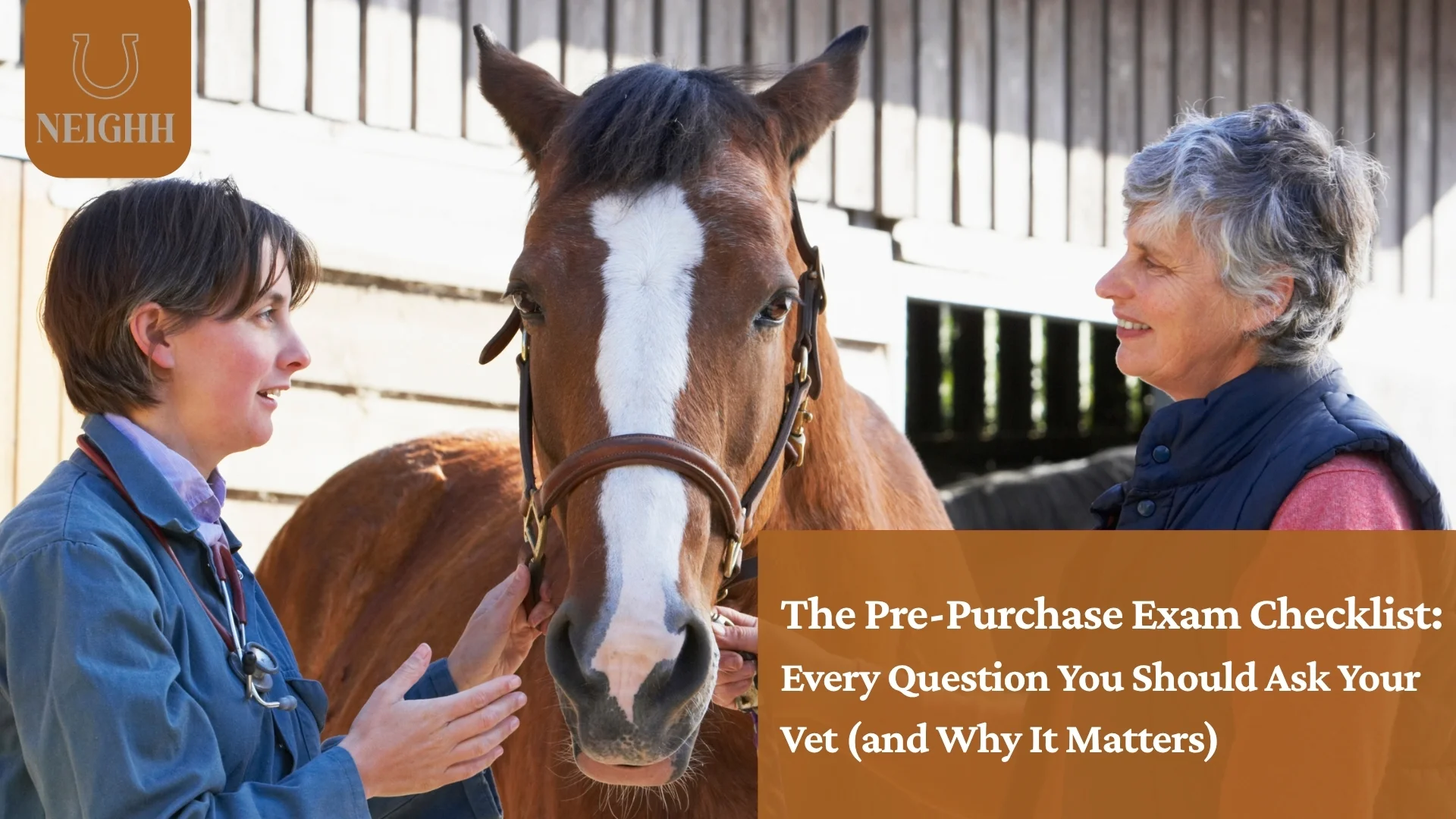
You've been horse shopping for weeks (or months). You've watched videos, scrolled listings, sent messages, and finally—finally—you found one that feels right.
Good mover. Sweet personality. In your budget. Checks all your boxes.
Now comes the part that separates smart buyers from costly mistakes: the pre-purchase exam.
And if you're like most people, you're probably thinking: "Okay, so... I just call a vet and they tell me if the horse is good or not, right?"
Not quite.
A pre-purchase exam (PPE) isn't a pass/fail test. It's not a guarantee. And it's definitely not as simple as "the vet says yes or no."
It's a detailed evaluation that gives you the information you need to make an informed decision—but only if you know what to ask, what to look for, and how to interpret what you're hearing.
So let's walk through it. Step by step. Question by question. Because the worst time to wonder "should I have asked about that?" is six months after you sign the check.
Why the Pre-Purchase Exam Matters (Even When It Feels Expensive)
Let's be honest: PPEs aren't cheap. Depending on where you are and what's included, you're looking at anywhere from $300 to $1,500+. And when you're already stretching your budget to buy the horse, it's tempting to skip it.
Don't.
Here's why: A horse might look sound, move beautifully, and have a perfect temperament in the ring. But there are things you can't see—old injuries, brewing issues, subtle lameness, metabolic problems—that can cost you thousands of dollars (and a lot of heartbreak) down the road.
The PPE isn't about finding the "perfect" horse. It's about understanding what you're getting into. It's about making sure the horse's limitations match your goals, your experience level, and your budget for ongoing care.
Think of it this way: Would you buy a house without an inspection? Would you buy a used car without having a mechanic look at it?
Your horse is a bigger investment than either of those. And unlike a house or a car, your horse's health directly impacts your safety.
So yes, the PPE costs money. But it's the cheapest insurance policy you'll ever buy.
Before You Schedule: What You Need to Know First
Before you even call the vet, there are a few things you should nail down.
1. Choose YOUR vet, not the seller's vet
This is non-negotiable. The vet performing the PPE should be someone you hire—not the horse's current vet, not the seller's barn vet, not their friend who "does it as a favor."
Why? Because the PPE vet works for you. Their job is to give you an unbiased assessment. If they have a relationship with the seller, there's a conflict of interest—even if it's unintentional.
Find a vet who specializes in sport horses or performance horses (depending on what you're buying). Ask other riders in your area for recommendations. And if you're buying out of state, ask your trainer or a local contact to recommend someone.
2. Know what level of exam you need
Not all PPEs are created equal. A basic exam might include:
Physical examination
Flexion tests
Watching the horse move (walk, trot, canter, on lunge)
Basic soundness evaluation
A more comprehensive exam might add:
X-rays (usually 2-view or 4-view, sometimes full set)
Ultrasound (for soft tissue)
Bloodwork (metabolic panel, drug screening)
Endoscopy (airway evaluation)
ECG (heart rhythm)
What you need depends on:
The horse's job (a low-level trail horse doesn't need the same workup as a grand prix jumper)
The horse's age and history
Your budget
Your risk tolerance
Talk to your vet ahead of time about what makes sense. And yes, budget for more than the minimum—because if something comes up during the basic exam, you'll want the option to dig deeper.
3. Be clear about your goals and limitations
Your vet can't tell you if this is "the right horse" unless they know what you need the horse to do.
Are you a nervous adult amateur looking for a confidence-builder? A junior aiming for the eq finals? A trail rider who needs something bombproof?
Are you capable of rehabbing an injury? Do you have access to top-tier vet care? Can you afford ongoing maintenance?
Tell your vet all of this upfront. It changes how they interpret findings.
During the Exam: The Questions That Actually Matter
Okay. You've scheduled the PPE. You've hired your vet. Now you're standing there watching them poke, prod, flex, and evaluate.
Here's what to ask—and when to ask it.
General Health & Conformation Questions
"What's your overall impression of this horse's conformation?" You're not looking for "perfect." You're looking for "functional for the job." Ask about anything that stands out—long backs, upright pasterns, offset knees, whatever. And ask if those things are likely to cause problems for what you want to do.
"Do you see any old injuries or signs of previous issues?" Scars, lumps, bumps, old blemishes—these tell a story. Some are no big deal. Some are red flags. Ask.
"How's their body condition? Any concerns?" Is the horse too thin? Too heavy? Muscle imbalances? Sometimes a horse looks fine to an untrained eye but a vet will spot things you miss.
"Any concerns with teeth, eyes, or overall condition?" Dental issues can affect performance and eating. Eye problems can be deal-breakers depending on severity.
Soundness & Movement Questions
"On a scale of 1-10, how sound is this horse right now?" This forces a specific answer instead of vague language. And follow up: "What would make you rate it higher or lower?"
"Did you see any lameness or irregularities in movement?" Even if the horse passed flexions, ask. Sometimes there are subtle things that aren't "lame" but aren't quite right either.
"Which flexions were positive, and what does that mean?" A positive flexion test doesn't automatically mean "don't buy the horse." It means there's sensitivity in that area. Ask what it could indicate and whether it's likely to progress.
"How did the horse respond to hoof testers?" Sensitivity in the feet can signal brewing issues—abscesses, navicular changes, thin soles, etc.
"Would you recommend any follow-up diagnostics based on what you saw?" If the vet suggests X-rays or ultrasound, listen. They're seeing something.
X-Ray Questions (if you're doing them)
"What are we looking for in these X-rays?" Common things: changes in joints (hocks, stifles, fetlocks), navicular bone changes, pedal bone issues, arthritis, bone chips, etc.
"What did you find, and how significant is it?" Ask them to walk you through each image. Don't just accept "it looks okay." Ask about any changes, even minor ones.
"Is this something that will get worse with work, or is it stable?" Some changes are old and dormant. Some are progressive. Know the difference.
"Would you buy this horse with these findings?" This is the gut-check question. Vets won't make the decision for you, but their answer tells you a lot.
"What kind of maintenance or management would this horse need?" If there are findings, ask what it means for care. Will this horse need injections? Special shoeing? Limited work? Time off?
Bloodwork Questions (if you're doing it)
"What bloodwork are we running, and why?" Common bloodwork includes a complete blood count (CBC), metabolic panel (kidney/liver function), and sometimes specific tests for metabolic conditions or drug screening.
"Are we testing for PPID (Cushing's) or Insulin Resistance?" If the horse is older (10+) or shows any signs (cresty neck, abnormal fat deposits, history of laminitis), ask about testing for these conditions. They're manageable with medication and diet, but you need to know upfront.
"Are we doing a drug screening?" This tests for substances like bute, ace, or other medications that might be masking pain or behavioral issues. If the seller has nothing to hide, they shouldn't object.
"What do these results tell us about the horse's overall health?" Ask the vet to interpret the numbers for you. Are there any red flags? Anything that needs monitoring? Anything that's borderline?
What you should do: Bloodwork adds cost, but it's worth it for peace of mind—especially if you're buying an older horse, a horse with an unknown history, or if anything seemed "off" during the physical exam. Always follow your vet's recommendations on what tests make sense for your situation.
Medical History Questions
"Can we review the horse's vaccination and deworming records?" You want to know the horse has been properly cared for. Gaps in records can be a red flag.
"Do you have access to any prior vet records or previous PPE results?" If the horse has been sold before, prior PPE results can show you if issues are new or longstanding.
"Has this horse ever colicked, tied up, or had any metabolic issues?" These are things sellers don't always disclose. Ask directly.
"Any history of lameness or injury?" Again—ask. Some sellers are honest. Some conveniently "forget."
Behavioral & Neurological Questions
"Did you see anything that concerns you neurologically?" Stumbling, coordination issues, hypersensitivity, or odd behavior can indicate neuro problems.
"How was the horse's temperament during the exam?" Dangerously reactive? Stressed? Calm? The vet sees a lot of horses—they'll know if something's off.
The Big-Picture Questions
"If this were your horse, what would you be watching or monitoring?" This gets the vet to think beyond the clinical findings and tell you what they'd actually do as an owner.
"Is there anything we didn't cover that I should be asking about?" Sometimes the best insights come from open-ended questions.
"What are the biggest risks with this horse, in your opinion?" Make them spell it out. Don't leave room for assumptions.
"On a scale of 1-10, how much risk do you think I'm taking on with this horse?" Another gut-check. Vets won't make the call for you, but they'll give you a read.
Reading the Results: What's a Deal-Breaker vs. What's Manageable
Here's the truth: Most horses will have something on a PPE.
Clean X-rays and perfect flexions are wonderful, but they're not the norm—especially if you're buying an older horse, a horse with a competition history, or a horse that's been worked regularly.
So how do you know what's okay and what's not?
Red Flags That Should Make You Walk Away
❌ Severe lameness that doesn't resolve If the horse is noticeably lame at the exam and it's not something acute (like a stone bruise), walk away.
❌ Neurological issues Stumbling, incoordination, ataxia—these are serious and often progressive.
❌ Significant heart or respiratory problems Unless you're buying a pasture pet, these limit the horse's performance and safety.
❌ Advanced arthritis or degenerative joint disease in a young horse If a 6-year-old has hocks that look like a 20-year-old's, that's a problem.
❌ Positive drug test or signs of recent medication to mask issues If the vet finds bute, ace, or other drugs in the system, the seller is hiding something.
❌ Major soft tissue damage (bowed tendons, suspensory issues) These can heal, but they're prone to re-injury and often end careers.
❌ Seller refuses to provide records or is evasive about history Trust your gut. If something feels off, it probably is.
Yellow Flags: Proceed with Caution (But Don't Panic)
⚠️ Minor arthritic changes in an older horse A 12-year-old with mild hock changes isn't a deal-breaker—it's normal wear and tear. Ask about maintenance needs.
⚠️ Mild positive flexions A horse that's slightly off after a flexion but works out of it quickly may be fine. Ask about long-term implications.
⚠️ Old, healed injuries with no current issues Scars and bumps from old injuries aren't necessarily a problem if the horse is currently sound.
⚠️ Metabolic markers that need monitoring (IR, PPID risk) Manageable with diet and care, but know what you're signing up for.
Green Flags: Things That Are Reassuring
✅ Clean X-rays (or age-appropriate changes only)
✅ Good body condition and muscle tone
✅ Calm, cooperative temperament during the exam
✅ Transparent seller who provides full records
✅ Horse moves freely and willingly
✅ Vet says "I'd be comfortable with this horse for your purposes"
After the PPE: Making Your Decision with Confidence
The exam is done. You've got the results. Now what?
Step 1: Review everything with your vet
Don't just read the report alone. Schedule a call or sit down with your vet and go through it line by line. Ask questions. Make sure you understand every finding.
Step 2: Talk to your trainer
If you have a trainer, loop them in. Show them the results. Get their take. They know your riding level and goals better than anyone.
Step 3: Consider the total cost of ownership
If the horse needs injections every six months, special shoeing, or ongoing monitoring—can you afford that? Factor it into your decision.
Step 4: Trust your gut
Sometimes the PPE comes back fine, but something still feels off. Listen to that. You're the one who has to ride this horse.
Step 5: Negotiate if needed
If the PPE reveals issues, you have options:
Walk away
Ask the seller to lower the price
Ask the seller to address the issue before purchase (injections, shoeing, etc.)
Proceed as-is, knowing what you're getting into
The Bottom Line
The pre-purchase exam isn't about finding a perfect horse. It's about making an informed decision.
A good PPE gives you:
A clear picture of the horse's current health
Insight into potential future issues
Leverage to negotiate if needed
Peace of mind that you did your due diligence
A horse can have findings and still be the right horse for you. Or a horse can pass with flying colors and still not be a good fit.
The PPE is a tool. Use it wisely. Ask the right questions. And trust the process.
Your Pre-Purchase Exam Checklist (Free Download)
We've put together a printable checklist you can take to your PPE. It includes:
Questions to ask before scheduling
Questions to ask during the exam
Red flags vs. yellow flags vs. green flags
Post-exam decision framework
Download your free PPE checklist here
And if you're in the middle of horse shopping—or thinking about listing your horse—do it somewhere that makes transparency the default. That's what Neighh is built for: clear listings, honest details, and helping buyers and sellers connect without the chaos.
Because the more information everyone has upfront, the better decisions we all make.
Good luck with your PPE. Ask the hard questions. And don't settle until you find the right horse for you.
Tags: pre-purchase exam, PPE checklist, buying a horse, horse vet check, pre-purchase exam questions, what to ask vet, horse shopping, PPE red flags, horse x-rays, flexion tests, horse lameness exam, first time horse buyer, horse buying guide, vet check questions, pre-purchase veterinary exam, horse health check, PPE cost, pre-purchase exam checklist, equine vet exam, sound horse, horse shopping tips