The Price of a Safe Horse: What Buyers Actually Need to Know in Today’s Market
In a market full of confusion, hidden details, and wildly different price tags, one truth remains: a genuinely safe horse has real value. Here’s what buyers should expect, what “safe” actually means, and how to protect yourself — and your future partner — in the process.
By Neighh Team ·
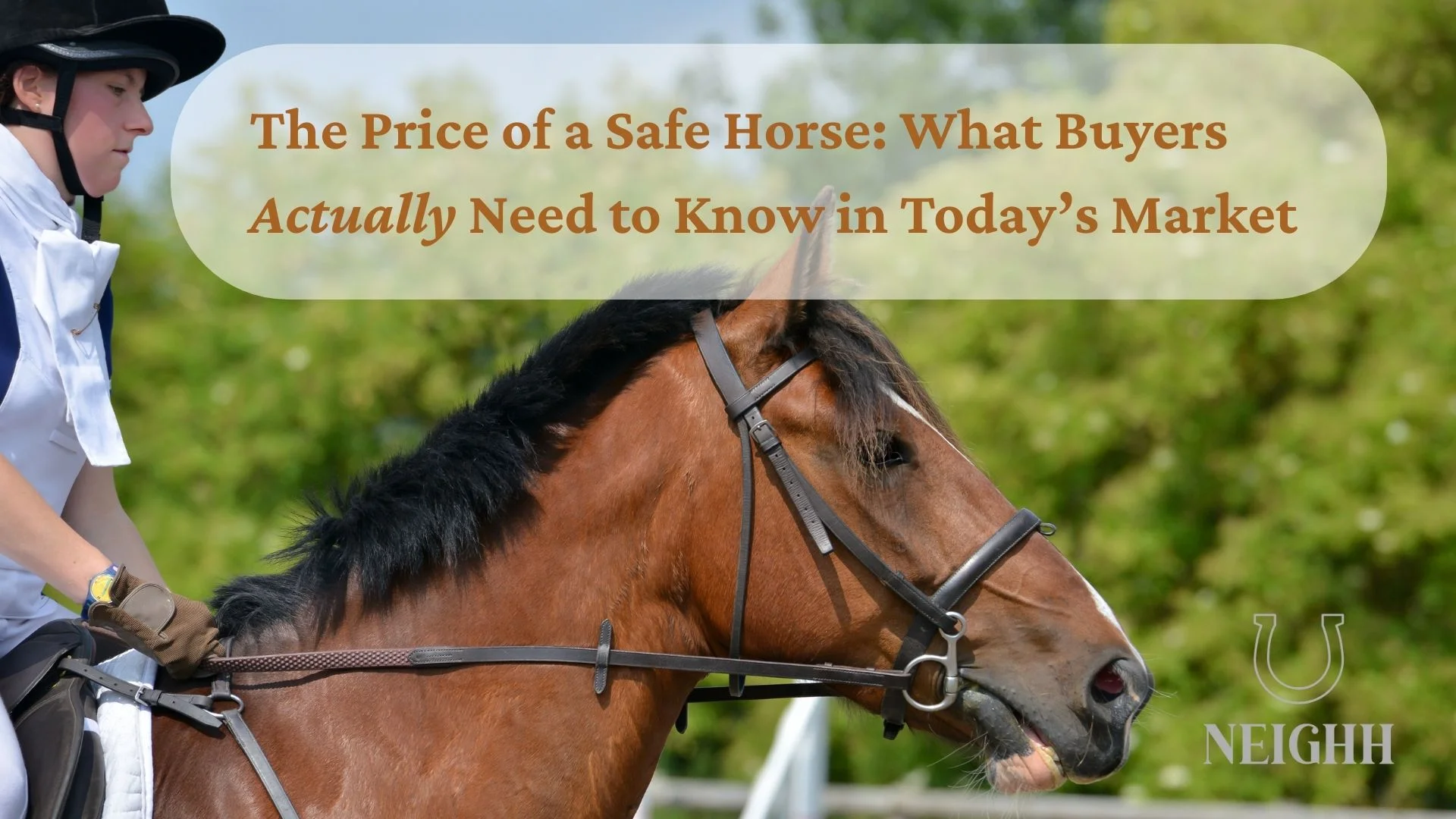
The Price of a Safe Horse: What Buyers Actually Need to Know in Today’s Market
Ask anyone in the horse world what they want most in a partner, and you’ll hear the same answer every time:
“Safe.”
Safe for kids.
Safe for amateurs.
Safe when it’s windy, or at a show, or when the unexpected happens (because with horses… it always does).
But in today’s market, “safe” has turned into one of the most overused — and misunderstood — words in horse listings. Prices feel all over the place, buyers feel confused or discouraged, and many don’t know how to evaluate whether a horse is truly safe… or simply advertised that way.
This guide breaks down what “safe” actually means, why these horses cost what they cost, and how to approach the market with clarity and confidence.
Because at Neighh, our commitment is simple:
Transparency helps people find the right matches — and protects horses from ending up in unsafe situations.
What “Safe” Actually Means (and What It Doesn’t)
A truly safe horse isn’t perfect.
They’re predictable.
They:
maintain their brain even when conditions change
forgive rider mistakes
don’t escalate when confused
have miles that prove their temperament, not guesses or hopes
can take a joke — and sometimes ten
“Safe” is not:
“hasn’t done anything yet”
“seems quiet in the pasture”
“green but sweet”
“should be fine for an intermediate rider”
Those aren’t safety indicators — they’re unknowns.
Real safety comes from experience, resilience, and consistency over time.
Why Safe Horses Cost What They Cost
The truth?
A safe horse is usually the most expensive category in the entire market.
Here’s why:
1. Miles matter — and miles cost money.
Training, showing, hauling, lessons, quality care — it all adds up.
Horses don’t magically become broke, confident partners. They’re made through investment.
2. Good brains are rare.
You can train behavior.
You can’t train temperament.
The unicorns with both? They’re in short supply.
3. They hold their value.
A safe horse will always have a market.
That keeps their price steady — even as the broader market fluctuates.
4. They reduce long-term risk.
Buyers are realizing what trainers have known forever:
The cost of a mismatched horse is higher than the cost of a fairly priced one.
Time, confidence, injuries, rehoming… a safe, suitable horse prevents all of that.
Realistic Price Ranges: What Buyers Should Expect
These ranges vary by discipline and location, but across the U.S. in 2025, the patterns are clear:
Truly beginner-safe: $15,000–$35,000+
Amateur-friendly (some maintenance OK): $20,000–$60,000+
Kid-safe ponies: $10,000–$45,000+
Green but sane prospects: $5,000–$15,000
Young, talented, still learning: $7,500–$25,000
Price is not a guarantee of quality — but safety does correlate strongly with both training and proven history.
This is why transparency is so important.
Buyers deserve to understand what they’re paying for — and sellers deserve to be able to show it clearly.
How to Evaluate Safety Quickly (And Avoid Red Flags)
When reviewing listings, look for:
✔ Consistency across environments
Arena, field, trails, indoor, outdoor.
✔ Media that shows the hard stuff
Not just pretty moments — the transitions, the corrections, the schooling.
✔ Uncut videos
Cuts often hide behavior.
✔ A clear description of experience
Years ridden, levels shown, who rides them, what they’ve seen.
✔ Honest limitations
Maintenance, workload, ideal rider type.
Honesty builds trust — and safe horses still come with needs.
✔ Seller responsiveness
A great seller helps you determine fit, not hide it.
The Biggest Myth: That Safety Is Guaranteed by Age or Breed
Safety is not defined by:
age
height
color
breed
discipline
It’s defined by history and temperament.
Some 6-year-olds are safer than 16-year-olds.
Some warmbloods are spicier than ponies.
Some OTTBs walk off the track safer than a backyard QH with no miles.
Labels don’t determine safety.
Proof does.
How Neighh Helps Buyers Understand Value — and Make Safer Matches
Our marketplace is built around one promise:
No more guessing. No more vague listings. No more missing details.
What you’ll find on Neighh:
Clearly documented experience
Honest training histories
Seller verification
Full photo + video requirements
In-app questions and advice to help buyers vet horses safely
Listings designed to show useful information, not just highlights
Safe horses deserve to be presented accurately.
Buyers deserve to understand what they’re looking at.
And horses deserve to land in the right homes the first time.
Final Thought: Safe Is Worth It — for Everyone Involved
Yes, safe horses can be expensive.
But clarity, transparency, and the right information can help buyers find the right partner at the right price — without heartache, risk, or wasted time.
When safety is the priority, horses stay safe.
Riders stay confident.
And our community becomes stronger.
That’s the future we’re building at Neighh.
Tags: safe horse prices, horse sales transparency, amateur-safe horse, beginner horse cost, Plaid Horse audience, Neighh marketplace, how to vet a horse listing, horse buying guide, safe horse value, horse market 2025