What We Pretend Doesn’t Matter (But Actually Does) in the Hunter Ring
We say hunters are about rhythm and relaxation. But color, breed trends, budget signals, and optics quietly shape perception long before the first jump. If we don’t acknowledge that, we can’t fix it — and riders and horses pay the price.
By Neighh Team ·
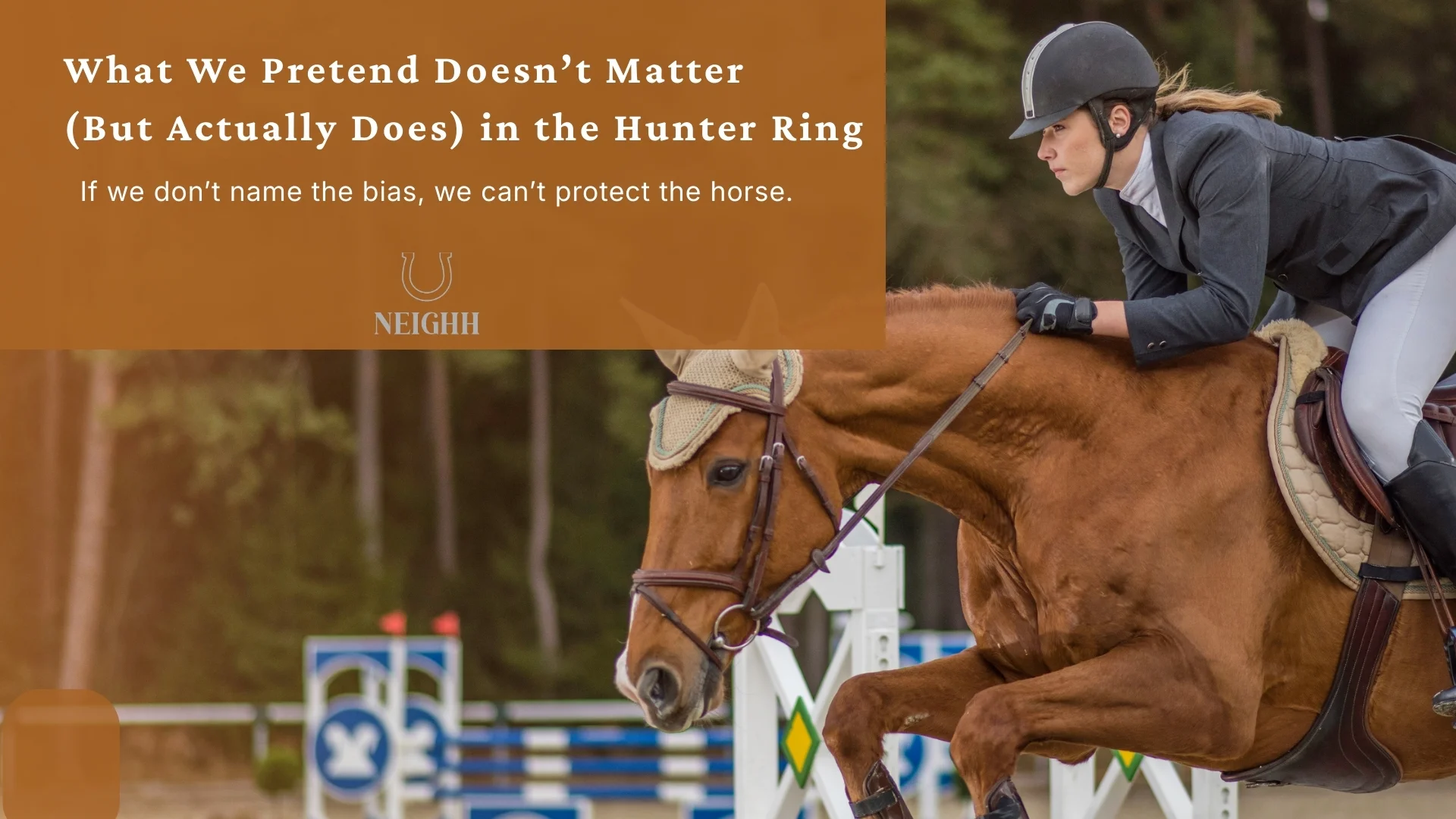
The hunter ring sells a simple narrative:
It’s about the round.
It’s about the quality of the canter.
It’s about a horse that looks like it could jump that course all day.
But if you’ve stood at the in-gate long enough, you know something else is happening.
Perception is shaping the story before the first fence is even jumped.
And the cost of pretending that isn’t true?
Riders doubt themselves.
Horses get labeled.
Buying decisions get distorted.
Breeding trends narrow.
If we care about this sport — and about horses — we need to talk about it honestly.
1. Color Bias: The Eye-Catcher Effect
A gleaming dark bay.
A striking grey under braids.
A horse that fits the postcard version of a hunter.
We can say color doesn’t matter — but human brains are wired to respond to aesthetics. First impressions are formed in seconds.
How It Impacts Riders:
Riders on less “fashionable” colors can feel behind before they start.
They may internalize lower placings as personal failure rather than optics at play.
Confidence erodes quietly.
How It Impacts Horses:
Certain types become more marketable.
Others are overlooked — not for performance, but for presentation.
Resale value becomes tied to appearance instead of ability.
When perception influences value, horses become products first.
That should make us uncomfortable.
2. Breed Bias: The Modern Hunter Silhouette
The modern hunter ring has a type.
Big-moving. Slow-legged. Effortless. Elastic.
That trend has elevated certain warmblood lines — and quietly edged out others, including the incredibly versatile Thoroughbred.
This isn’t about nostalgia. It’s about range.
How It Impacts Riders:
Buyers feel pressured to shop for “the look.”
Amateurs may stretch budgets chasing a silhouette.
Riders on sharper or lighter types get told their horse “isn’t quite the style.”
How It Impacts Horses:
Breeding narrows toward one aesthetic.
Athletic, brave, adaptable horses become undervalued.
Horses that don’t fit the mold are shuffled into other disciplines — not because they can’t perform, but because they don’t match a trend.
When style becomes more important than substance, we lose diversity in the sport.
3. Brand & Program Signaling
We all see it.
The impeccably tailored coat.
The recognizable saddle brand.
The braids done by a professional.
The trainer whose reputation walks into the ring first.
None of that is on the scorecard.
But subjective sports are influenced by context.
How It Impacts Riders:
Amateurs can feel like they’re competing against programs, not just rounds.
Budget-conscious riders may feel invisible.
Success can feel inaccessible.
How It Impacts Horses:
Horses in major programs gain perceived value.
Horses in smaller programs may need to prove themselves twice as hard.
Market pricing inflates based on association, not always performance.
That shapes who gets opportunities — and who doesn’t.
4. The “Fancy” Illusion
There’s a moment in every classic when the crowd leans in.
That bascule.
That lope.
That float.
Sometimes it’s genuine brilliance.
Sometimes it’s training, polish, exposure, and repetition at major venues — all of which cost money.
Money doesn’t buy a ribbon.
But access buys preparation.
How It Impacts Riders:
Riders may believe talent alone should overcome access gaps.
When it doesn’t, they blame themselves.
Burnout follows.
How It Impacts Horses:
Young horses are pushed to look “made” earlier.
Prep routines become longer and more artificial.
Horses that require more time are moved along faster.
When the illusion becomes the expectation, development suffers.
So What Do We Do About It?
Acknowledging bias isn’t an attack on judges.
It’s an invitation to evolve.
Here’s our take:
1. Make the Conversation Normal
Trainers should openly discuss optics with clients — not as shame, but as context.
Transparency builds trust.
2. Reward Substance Publicly
Celebrate rounds that are correct and kind — not just flashy.
Feature diverse types in media coverage. Show the range of what quality looks like.
3. Broaden the Definition of “Hunter”
A good hunter is:
Adjustable.
Relaxed.
Straight.
Kind in the bridle.
Consistent.
That can come in more than one silhouette.
4. Stop Letting Value = Aesthetic Alone
Buying decisions should factor:
Rideability.
Soundness.
Longevity.
Temperament.
Suitability for the rider.
When resale markets inflate aesthetics, horses become transactional. That trickles down into how they’re trained and how quickly they’re moved.
And that’s where the welfare conversation begins.
This Isn’t About Tearing Down the Sport
Hunters are beautiful because they reward feel.
But feel requires awareness.
If we care about horses — truly — we can’t pretend perception doesn’t shape opportunity.
Because when riders feel inadequate for factors beyond their control, they leave.
And when horses are valued primarily for optics, they get cycled faster.
Clarity protects both.
Let’s Actually Talk About It
What do you think influences outcomes more than we admit?
Color?
Program?
Breeding?
Budget?
Exposure?
The sport doesn’t get weaker when we examine it.
It gets stronger.
Tags: hunter ring bias, equestrian industry, hunter jumpers, thoroughbred, warmblood, equestrian transparency, horsemanship, horseshow culture, hunter discipline, horse welfare