The Disappearing Mid-Level Horse: Why It’s Getting So Hard to Find Something Between $5K and $50K
Across the country, riders are facing the same frustration: affordable, capable horses are vanishing. What used to be the sweet spot of the market — safe, sane, mid-range partners — now feels like a myth. What happened to the middle, and what does it mean for the future of everyday riders?
By Neighh Team ·
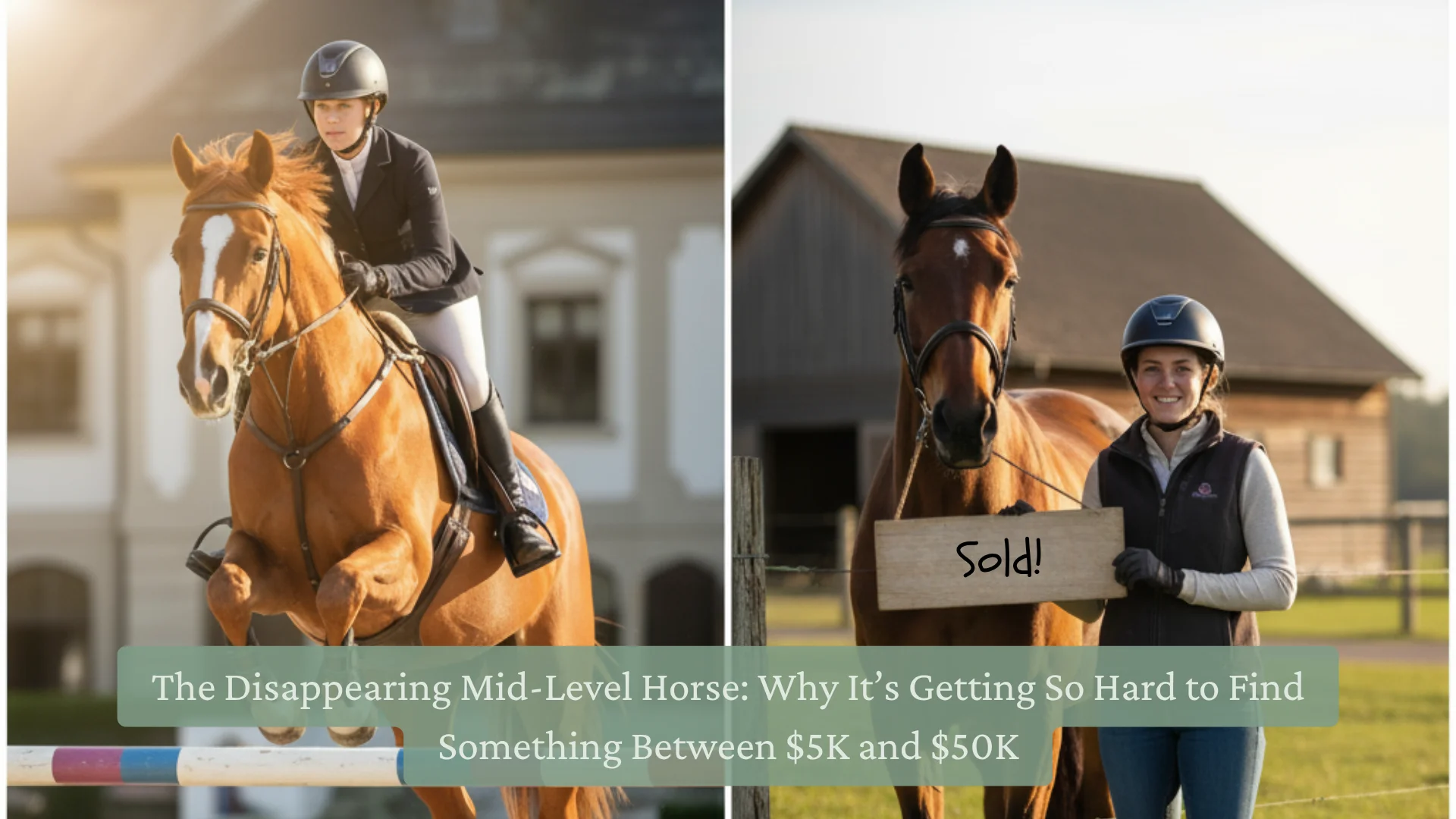
If you’ve spent any time scrolling sale ads lately, you’ve probably noticed a pattern: there’s the “project” horse priced under $5,000, and the polished, show-ready import well into six figures.
And somewhere in between — the solid 3’ packer, the reliable lower-level eventer, the all-around family type — there’s… silence.
The mid-level horse, once the backbone of the American riding scene, is becoming increasingly rare. Riders are calling it “the great vanishing act,” and it’s reshaping how people buy, sell, and stay in the sport.
A Market Split in Two
Not long ago, you could find a safe, serviceably sound, decently schooled horse for $15,000–$30,000. Today, that same kind of partner is listed at $60,000 — or nowhere to be found.
Trainers and buyers alike cite the same causes:
The cost of care has exploded. Feed, bedding, insurance, and veterinary costs have climbed sharply since 2020. For a trainer bringing along resale horses, the math simply doesn’t work unless the final price justifies the investment. (American Horse Publications Survey)
Imports have reset expectations. With the flood of young European horses marketed as “made” for the U.S. amateur, domestic pricing has had to chase that new baseline.
The pandemic surge changed demand. COVID pushed an influx of new buyers into the market, many with flexible remote jobs and disposable income. When they bought up the inventory of safe horses, prices jumped — and haven’t fully come down.
Amateur breeders and resellers are burning out. The people who once produced those mid-range “unicorns” — amateur riders who loved bringing along nice, affordable types — are leaving the game because of rising costs and limited returns.
The result? A market that caters to the extremes: those with deep pockets and those with patience for projects.
Who’s Getting Left Behind
For many everyday riders — the lesson-program graduate ready for their first horse, the re-rider balancing career and kids, or the small program trainer building a sale string — this squeeze is heartbreaking.
These are the people who keep the sport alive: they fill local shows, support barns, and create the next generation of equestrians. Yet many now feel priced out of horse ownership entirely.
One trainer summed it up bluntly in a recent discussion on the Chronicle of the Horse forums in a recent discussion:
“There used to be a $25,000 horse for every rider who worked hard and saved. Now, that horse is $75,000 — if you can find it at all.”
When the middle disappears, so does accessibility. And that threatens not just the market — but the community itself.
The Emotional Cost
It’s not just about dollars. Riders report emotional exhaustion from the endless search — the too-good-to-be-true ads, the disappointments at PPEs, the fear of being scammed online.
Buying a horse has become less about falling in love and more about survival strategy. “It used to be fun,” one buyer said. “Now it feels like trying to win an auction in a panic.”
That fatigue is pushing many toward leasing or giving up altogether. But for others, it’s motivating a quieter movement: reclaiming the middle through transparency, community, and smarter matchmaking.
(Related: The Emotional Side of Selling a Horse (That Nobody Talks About))
Rebuilding the Middle Ground
While the macro-economics may be tough, there are small glimmers of hope. Some trainers are partnering with nonprofits to repurpose OTTBs and rescues into steady, mid-range horses. Others are leaning into digital networks that connect buyers and sellers more efficiently, cutting down the guesswork and middlemen that drive up costs.
Platforms built by riders are helping give these horses visibility again — the sound, kind, useful partners who just need the right exposure to the right people.
Because maybe the middle isn’t disappearing after all. Maybe it’s just been buried under noise, waiting for riders to find each other again.
(Also read: Should OTTBs Be Given Time Off — or Restarted Right Away?)
The Heart of It
At its core, this isn’t a market story — it’s a people story.
Riders aren’t asking for perfect. They’re asking for possible.
The horse that can teach, build confidence, jump around 2’9”–3’3”, hack out safely, and come home to a clean stall and a carrot. The kind of horse that made so many of us fall in love with this sport in the first place.
If we want a healthier future for equestrian sport, we have to make space for those partnerships again — in our barns, our budgets, and our online listings.
.
Tags: horse market trends, affordable horses, mid-level horse prices, U.S. equestrian industry, OTTB, horse buying tips, hunter jumper market, horse sales 2025, equine economy, Neighh blog